
Wyandotte County Three-Day Release Method
The Wyandotte County Sheriff does not publish a control labeled Past 72. The supported method begins at the official Sheriff Inmate Search and continues into BlueHorse. Choose Past Inmate, then set start and end dates that cover the desired three days. This is a first-party historical query, not a separate rolling feed.
The distinction matters. Past 24 calls a built-in recent-history function. A three-day lookup depends on the dates entered by the user. Define the period first, include the full calendar dates needed, and note when the search was run. No maximum archive-retention promise was found.
Search Wyandotte County 72-Hour Releases
Past Inmate offers more control than the same-day view. It accepts first name, last name, Perm ID, State ID, start date, and end date. Dates use the format shown on the form. A broad date-only query answers who appears in that span, while a name or identifier narrows the results.
- Open the Sheriff gateway and proceed to BlueHorse.
- Select Past Inmate, not Current Inmate or Past 24.
- Enter a start and end date spanning the three calendar days at issue.
- Add a name or identifier when checking one person.
- Open the historical detail and read Release Date, booking time, arrest agency, holds, bonds, charges, and court data.
- Compare the result with the proper court and any later custodian.
If the event happened today, the Wyandotte same-day release view is faster. The three-day method is better for a weekend or an uncertain date.
Wyandotte Three-Day Record Fields
A selected historical record can expose several linked panels. Treat blank fields as blanks, not proof that no charge, bond, or hold existed. The application also attempts to load a booking JPEG and uses a generic image when no jail photo is supplied.
| Displayed item | How to read it |
|---|---|
| Release Date | The end date for that Wyandotte booking. |
| Booking date/time | The start of the local jail event. |
| Arrest agency | The agency connected to intake. |
| Charge detail | May include code, text, type, disposition, case, OTN, and offense date. |
| Hold or detainer | May identify another agency and explain a transfer. |
| Bond | May list agency, type, amount, method, and status. |
Release Date establishes that the local booking ended. It does not by itself establish where the person went. A court order, transfer notation, KASPER movement, or federal record may be needed for that answer.
Use more than a name when joining records across the three-day span. A permanent identifier, state identifier, booking date, case number, or date of birth can separate people who share a name. Keep the arrest agency because it helps select the next court. KCK ordinance cases and Kansas criminal cases follow different court routes even though both populations may pass through the Adult Detention Center.
Wyandotte Weekend Release Checks
A three-day span reduces the risk of missing an event merely because the one-day view rolled forward. It is useful after a weekend, holiday, or any gap between the expected exit and the search. The Sheriff says jail changes normally post within a few minutes, but that general cadence is not a guarantee for every record.
Weekend timing also affects the fallback systems. KASPER updates each working day and skips weekend updates. Court documents may appear after the custody event. VINE depends on the county booking feed. When times conflict, favor the source that created the event and ask the custodian rather than forcing all dates to match.
A court order for bond, probation, dismissal, or time served provides legal authority, but it may not give the exact door time. Another hold can delay or redirect the exit. The jail release transaction is the better source for the physical end of county custody.
Run the date range again with one extra day only when the expected time sits near the edge of the chosen span. Keep the original search dates in the notes. This avoids turning a three-day question into an undefined archive search. If a result appears on the added day, report the displayed Release Date instead of saying it belonged to the original window. Calendar boundaries, posting time, and the actual custody timestamp are separate facts.
Resolve Missing Wyandotte Release Results
An empty Past Inmate result has several possible causes. The spelling may differ, the dates may miss the event, the person may have been booked in another county, or the public archive may not retain the desired record. Search with a known Perm ID or State ID when available. Then check Kansas VINE for an adult county-jail custody change and the proper court for the case outcome.
If the case shows commitment to the Kansas Department of Corrections, leave the county search and use KASPER. A person who bonded out locally without a KDOC sentence may never appear there. For a federal commitment, use the BOP locator and federal docket. A known immigration transfer belongs in the ICE locator. These systems cannot substitute for each other.
The Unified Government NextRequest portal is the formal local fallback. Ask for the public booking and release transaction, actual release date and time, release or destination code with its definition, bond or release order, and transfer notation. K.S.A. 45-218 requires action as soon as possible and, if access is not immediate, a response by the end of the third business day that grants access, explains delay, or states a denial. It does not guarantee production in three days.
Request electronic records and ask for a cost estimate before processing. The Unified Government may charge reasonable actual costs, but no fixed price for a Sheriff release record is published. Do not send unnecessary sensitive identifiers. If part of the transaction is withheld, ask the custodian to release the segregable public fields and identify the precise statutory basis for each closure.
Wyandotte Release Status Boundaries
The current jail roster describes active local custody. Past Inmate describes a former Wyandotte booking. Neither alone settles every later status. A transfer ends the county event while confinement continues. Postrelease means a KDOC prisoner has entered community supervision. Discharge means KDOC control over the represented sentence ended.
A sentence of time served can authorize an exit, yet another warrant or detainer can keep the person confined. Probation describes a court sentence and supervision relationship, not the precise moment the jail door opened. Bond can end present detention while the case continues. These distinctions are why the three-day jail result and the journal entry should be read together.
- Released booking
- A local jail transaction has ended.
- Detainer
- A hold placed by another authority.
- Transfer
- A handoff to another facility or agency.
- Time served
- A court sentence credit that may permit release if no other hold applies.
For one named person, the Wyandotte County release-record paths bring together jail, court, state, federal, and request channels. Do not infer a release from disappearance alone.
Why Wyandotte Uses Past Inmate
The county gateway is generically named Inmate Search, yet the BlueHorse system has two release-first tools. Past 24 supplies the recent list. Past Inmate supplies identifiers and a date range. That local design is why a truthful three-day lookup is a date query rather than a link advertised as a 72-hour feed.
Past Inmate also helps when the arrest agency was Kansas City, Kansas Police, Bonner Springs Police, Edwardsville Police, Kansas Highway Patrol, or another agency that books at the Adult Detention Center. Start with the county booking trail even when the arresting badge was municipal or state. Then use the case number and charge type to choose the correct court.
The BlueHorse application shows both routes on the same interface.
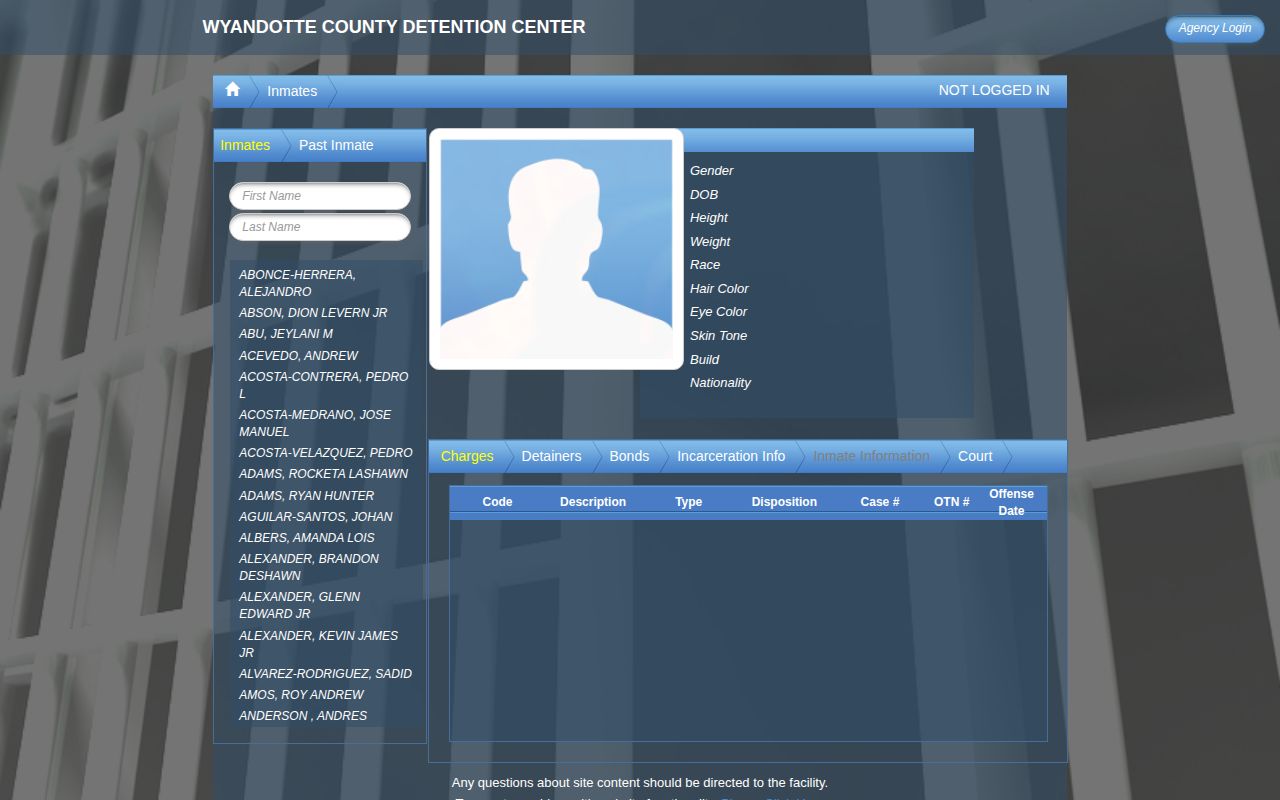
The Past Inmate controls, not a nonexistent Past 72 button, support the wider Wyandotte County release window.
Confirm Wyandotte Three-Day Identities
A three-day date query can return several bookings and common names. Match the historical result with Perm ID or State ID when displayed, booking date and time, arrest agency, case number, and lawful birth or physical details from the linked official record. Do not combine two entries merely because the names resemble each other.
Use the case number to select the court and read the latest custody-changing order. A bond status can explain why detention ended, while a hold panel may point to another custodian. If the result contains a generic silhouette, treat it as a placeholder rather than identity evidence.
Preserve the exact start and end dates used in Past Inmate. A later rerun may produce a changed result as records update. When one extra boundary day reveals the event, report the displayed Release Date and do not claim it fell inside the original three-day span. A focused Sheriff request remains the final source for an unclear timestamp or destination.